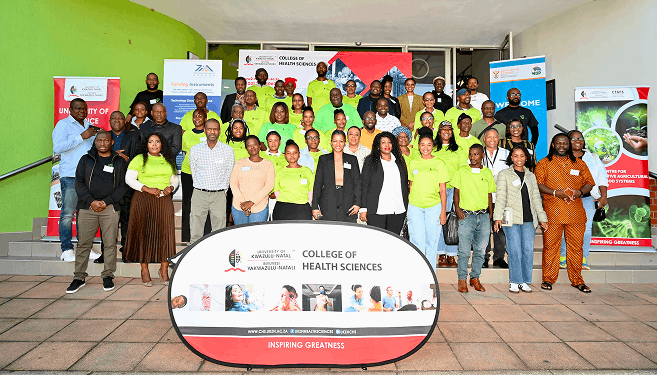
The University of KwaZulu-Natal (UKZN) has officially launched the Hluma Centre for Entrepreneurship and Rapid Incubator (CFERI), a pioneering programme led by the College of Health Sciences and the College of Agriculture, Engineering and Science.
The Centre was launched in a bid to integrate traditional medicine, indigenous crops, and innovation to drive entrepreneurship, economic development and inclusive growth; and brings together researchers, industry partners, government agencies, as well as emerging entrepreneurs to unlock the commercial potential of Africa’s indigenous knowledge systems while strengthening food security, health innovation, and township and rural development.
Hluma Co-Director, Professor Nceba Gqaleni, highlighted UKZN’s leadership in traditional medicine and indigenous knowledge systems research, noting the University’s unique position on the continent.
“I must proudly say that we are the only university in sub-Saharan Africa with a Traditional Medicine discipline. I think I’m not afraid to say in Africa…we’ve embraced this broad spectrum of health and medicine,” said Gqaleni.
He reflected on the philosophy underpinning the programme, emphasising the enduring relationship between food and medicine in African knowledge systems.
“What we historically knew when growing up is that our food is our medicine, and our medicine is our food. That’s what we are bringing here today,” he said.
Gqaleni also outlined the programme’s structure, which included presentations on Hluma, partner engagements, site visits to agricultural and research facilities, and a final networking and business session designed to connect entrepreneurs with potential funders and collaborators.
Deputy Vice-Chancellor of the College of Agriculture, Engineering and Science, Professor Fhatuwani Mudau, described Hluma as a strategic shift toward innovation-driven development, stressing the importance of translating scientific research into real-world economic value.
“Innovation is good, but we’ve got to bring something tangible to the table so that we can see how our science transforms society,” he said.
He added that universities must go beyond traditional academic roles to become active contributors to economic development, job creation, and entrepreneurship ecosystems.
A central feature of Hluma is its focus on indigenous crops and underutilised food systems. Professor Tafadzwa Mabhaudhi, Hluma Co-Director, detailed years of work identifying and developing priority crops, including sorghum, millet, Bambara groundnut, sweet potatoes, cassava, and indigenous leafy vegetables. These crops were selected for their resilience to climate change, nutritional value, and potential for commercialisation.
The programme also builds on extensive research into medicinal plants, nutrition, climate resilience, and seed systems with the aim of developing value chains that include production, processing, product development, and market access.
“We cannot just grow crops; we must ask what else we can do with them. We must develop products, markets, and businesses that include communities at every level of the value chain,” one researcher noted.
Hluma is further supported by a network of strategic partners, including government departments, research councils, and innovation agencies such as the Council for Scientific and Industrial Research (CSIR), Technology Innovation Agency (TIA), Water Research Commission, and several development and incubation organisations.
Speakers from incubation and enterprise development agencies emphasised that Hluma aligns with national priorities of job creation, Small and Medium Enterprises (SME) development, and inclusive economic participation. The programme is expected to support youth, women, and rural entrepreneurs by providing training, incubation, product testing, access to funding, and business development support.
The initiative also seeks to strengthen intellectual property (IP) commercialisation pathways while ensuring equitable benefit-sharing and avoiding monopolisation of indigenous innovations.
Hluma is positioned as a long-term platform that connects science, indigenous knowledge, and entrepreneurship to build a sustainable African bioeconomy.
As the programme moves forward, UKZN says it aims to scale Hluma into a nationally and internationally recognised model for indigenous knowledge-driven innovation, with the potential to reshape how African universities contribute to economic transformation.
Words: Nombuso Dlamini
Photograph: Albert Hirasen