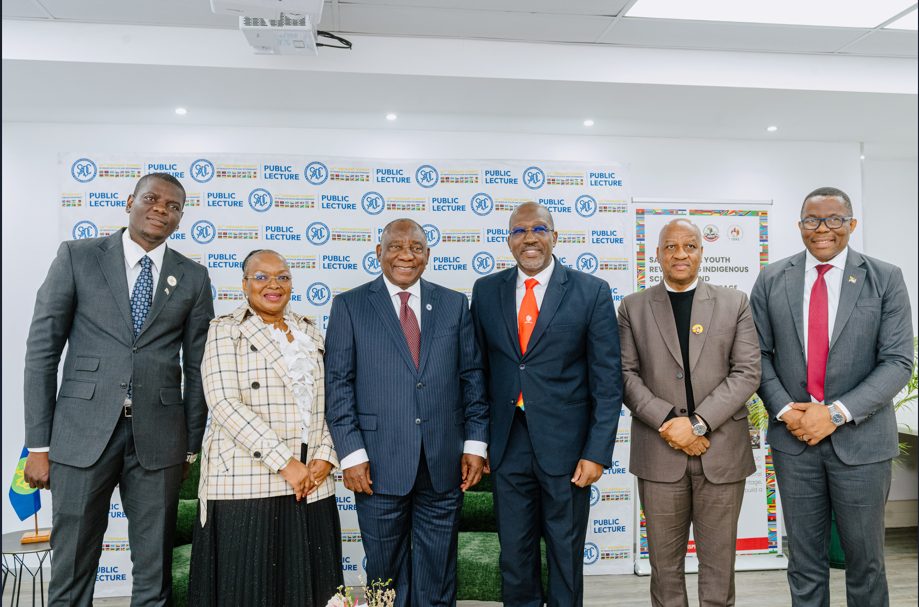
President Cyril Ramaphosa has called for great urgency in translating the Southern African Development Community (SADC) Vision 2050 from a long-term aspiration into practical action that delivers tangible benefits for people across the region.
Ramaphosa was delivering the keynote address at the SADC Public Lecture hosted by the University of KwaZulu-Natal (UKZN) at the Westville Campus on Friday, 14 August.
Held under the theme: “Translating SADC Vision 2050 into Action: Pathways Towards Solidarity, Equality and Shared Prosperity”, the lecture formed part of the programme of South Africa’s hosting of the 46th Summit of Heads of State and Government of SADC.
Bringing together key figures across government, academia, business, and diplomacy, the event focused on regional integration under Vision 2050. It emphasised higher education as a vital catalyst for innovation and skills development, keeping young people at the core of Southern Africa’s growth.
Ramaphosa said it was fitting that the discussion on Southern Africa’s future was taking place at a university, noting that the region’s future would be shaped in lecture theatres, laboratories, workshops and centres of innovation.
Welcoming Ramaphosa, the SADC Secretariat and other guests to the event, UKZN Chair of Council, Ms Khomotso Mthimunye, said hosting the lecture spoke directly to the University’s identity and its role in advancing development in South Africa, the region and the continent. “For us, hosting this lecture speaks directly to who we are as a University, what we stand for and the role that higher education plays in advancing the development of our country, our region and our continent,” she said.
She said UKZN, as a Premier Institution of African Scholarship, recognised its responsibility not only to knowledge generation, but to contribute meaningfully to society. Mthimunye also noted that the University’s relationship with SADC was already a lived reality, with the majority of its international students coming from SADC Member States.
Ramaphosa said Vision 2050 must influence government decisions, budgets, infrastructure development, skills development and institutional strengthening, but ultimately must deliver results that can be seen and felt in the lives of citizens, especially the youth. Addressing students directly, the President reminded them that they would be the generation responsible for shaping the Southern Africa envisaged in Vision 2050. “Vision 2050 is not our document. It is yours, and you are entitled to demand an account of what we did with it.”
He called for greater regional industrialisation, arguing that SADC countries should use their collective natural resources, markets, infrastructure and human capital to build stronger regional value chains. He cautioned against the continued export of raw materials and importation of finished products, particularly in the critical minerals sector, saying the region should process more of its resources locally and create jobs through manufacturing.
Agriculture was also highlighted as a key sector requiring greater investment and support. Ramaphosa called for modernisation of the sector through improved irrigation, climate-resilient seeds, veterinary science and agro-processing.
UKZN agricultural student, Ms Amaningi Madlopha, applauded the President’s focus on young people and agriculture as particularly meaningful. “As a young person and a student at the UKZN, listening to President Ramaphosa place young people at the centre of SADC Vision 2050 was a very affirming moment for me. His message that education and skills development must be directly connected to meaningful economic opportunities spoke to the reality that many of us as graduates face, where we hold qualifications but struggle to find a place in the economy,” she said.
Madlopha said Ramaphosa’s comments on agriculture offered hope for young people seeking to build careers and businesses in the sector. “As an agricultural student myself, I felt seen in that moment. It made me feel that there is a brighter future being imagined, especially for us as young farmers who want to build our lives in this sector”.
Ramaphosa described the region’s young population as one of its greatest strategic assets, noting that more than half of SADC’s population is under the age of 30. He warned, however, that this demographic dividend could only be realised through investment in education, skills development, entrepreneurship and meaningful economic opportunities. He acknowledged UKZN’s contribution to the realisation of SADC Vision 2050, highlighting its work in regional value chains in agro-processing and critical minerals, ethical artificial intelligence and digital inclusion, climate-resilient agroecology, and human capital development through youth and women entrepreneurship programmes.
He also commended UKZN researchers, academics and intellectuals for their contribution during the COVID-19 pandemic, highlighting the University’s leading contribution to the discovery of the Omicron variant in 2021 and its significance beyond South Africa.
In conclusion, Ramaphosa urged SADC to move decisively from aspiration to implementation, saying Vision 2050 is now a programme of work with actions, responsibilities and deadlines.
Words: Lungile Ngubelanga
Photographs: Sethu Dlamini