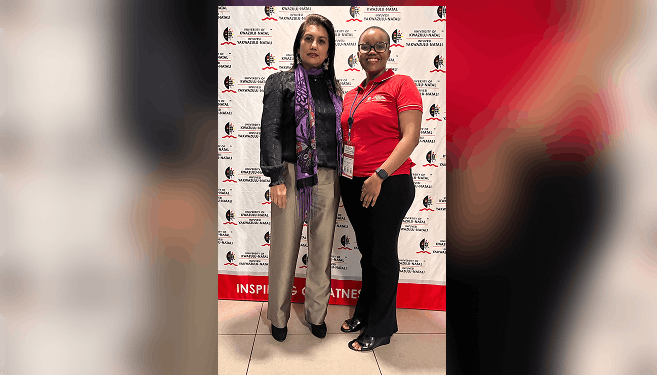
As part of the ‘Digital Curriculum Transformation’ project, UKZN’s Professor Sadhana Manik recently collaborated with module instructional and learning designer, Ms Pertunia Mutheiwana, to present at the two-day Instructional and Learning Design Symposium, held under the theme ‘Advancing Digital Curriculum Transformation through Evidence-Led Design’.
Manik’s presentation, titled ‘Beyond the Classroom: Innovating Geography Teacher Education Through Participatory Action Research and Moodle-Supported Learning’, explored an innovative teaching approach using Participatory Action Research (PAR) and a redesigned Moodle-supported learning environment.
The presentation addressed challenges facing one of the School of Education’s high-impact Geography modules, including high enrolment numbers, low attendance, low pass rates, and to avoid the increasing use of artificial intelligence (AI) tools by students in their assessments.
Reflecting on the challenges Manik noted: “One of our highest-impact modules by student numbers, year on year, shows low attendance. Enrolment volume has not translated into consistent class participation.”
Mutheiwana explained that the response involved a two-pronged strategy that combined a pedagogical intervention with a redesigned digital learning environment.
“To manage enrolment pressure and increase engagement, we combined a pedagogical approach with a redesigned digital environment.”
Through PAR, underpinned by the Sustainable Development Goals (SDGs), groups of student teachers engage directly with real local environmental challenges, such as wetland degradation and water pollution, rather than relying on simulated case studies. This approach promotes critical thinking, collaborative learning at scale, civic environmentalism and community ownership of responses to environmental challenges. The PAR model also divides large classes into manageable, accountable learning teams, in which students conduct fieldwork, interviews and reflective activities that encourage active engagement rather than passive participation.
Complementing this, the Moodle-Supported Learning (MSL) component transformed the Learn site from a static content repository into an interactive teaching and project space. Features introduced include digital badges, interactive activities, gated progression between topics, attendance incentives and project-based collaboration tools designed to increase participation and engagement.
One particularly innovative feature is the ‘Wetlands Photo Challenge’, which links in-person class attendance to progress on students’ group projects. Students must upload a group photo taken in class to unlock clues that help them improve their wetland rehabilitation projects, thereby encouraging attendance and teamwork.
The redesigned Moodle environment also incorporates interactive slides and checkpoint quizzes, which require students to demonstrate understanding of one topic before the next becomes accessible. According to the presentation, this creates a more structured and engaging learning pathway.
Manik highlighted that the PAR initiative has already fostered cross-institutional collaboration, with the project now involving partners in South Africa, Tanzania and Norway. The collaboration has enabled the sharing of pedagogical strategies, digital learning practices and community-based Geography education approaches across different contexts.
The symposium presentation outlined several benefits of the initiative, including:
- more manageable large-class teaching through structured group collaboration;
- deeper learning through authentic, action-based tasks;
- a consistent digital learning experience that integrates content, projects and feedback;
- cross-institutional knowledge exchange;
- real-world community impact through projects such as wetland rehabilitation; and
- shared ownership between students, lecturers and partner institutions.
Looking ahead, Manik indicated that the team plans to integrate the Moodle-supported model into existing PAR on food security at honours level, publish the cross-institutional collaboration model in a peer-reviewed journal, develop isiZulu translations of key learning materials and expand reusable Moodle content resources.
Words: Sinoyolo Mahlasela
Photograph: Supplied