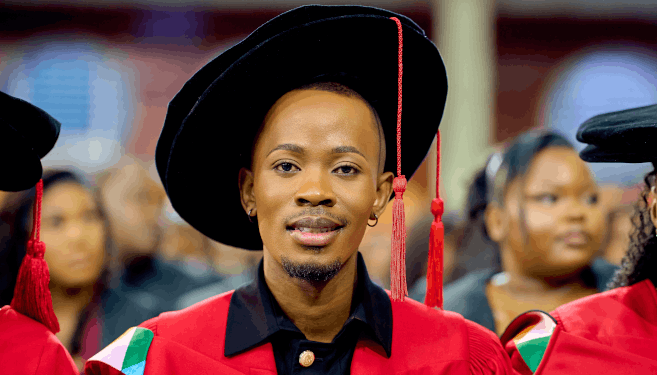
With a background in criminal justice services and extensive research on offender reintegration and correctional programmes, Dr Sethenjwa Nduli recently graduated with a PhD focusing on elderly offenders.
Supervised by Dr MN Mthembu, his research explored the experiences of terminally ill elderly parolees, as well as those of family caregivers, who often have little choice when it comes to caring for terminally ill relatives.
Nduli’s study was titled: ‘End-of-life Care During Reintergration from the Perspectives of Correctional Social Workers and Caregivers Providing After-care Services to Elderly Parolees Released on Medical Parole in eThekwini Metropolitan Municipality’. “My study sought to examine the challenges, available support systems, and emotional dynamics involved in providing care to elderly parolees during this phase of reintegration, as well as to identify the roles and perspectives of family caregivers and correctional social workers in either facilitating or hindering this process,” he said.
The study revealed significant findings with important policy and practice implications. Elderly individuals on medical parole experience severe emotional distress during reintegration, compounded by terminal illness and inadequate post-release support. This highlights the absence of a structured care framework to meet their complex needs.
According to Nduli, caregivers – often family members – face emotional fatigue and psychological strain due to insufficient training and limited support, with some expressing regret over assuming these roles. This exposes a critical gap in the parole system, which tends to overlook caregiver well-being despite their central role.
His findings also emphasise the need for specialised end-of-life care training and consistent support from correctional social workers to improve care quality, reduce isolation, and strengthen caregiver confidence.
Speaking about the challenges he faced during data collection, Nduli said gaining access to the Department of Correctional Services proved difficult, as the department was required to assist with recruiting family caregivers of elderly parolees. This placed additional demands on its operations and resulted in delays.
Additionally, many participants were sole caregivers who expressed frustration and distress due to insufficient support from the Department of Correctional Services.
“These circumstances made it difficult for correctional social workers to trace and engage caregivers. An additional barrier was that some elderly offenders released on medical parole were discharged directly to their homes without the knowledge or involvement of correctional social workers, which significantly limited access to potential study participants,” said Nduli.
“During this same period, I also experienced the devastating loss of my twin brother, which had a profound impact on my emotional well-being. Remarkably, the news of his passing came just one day after I had submitted my chapter on death and dying. Navigating this loss while continuing my doctoral journey required immense resilience. Despite grieving deeply, I remained committed to completing my research and ensuring that sorrow did not overwhelm my purpose or determination,” he added.
Nduli admits that balancing the demands of a PhD and family life was challenging, as he was often preoccupied with revisions and research commitments. However, his family’s unwavering support kept him motivated during difficult times.
“I am deeply blessed to have a mother who understands and honours the academic pursuit, and I wish everyone could experience such unconditional support. I am forever grateful to my ‘deputy parents’, my eldest brother, and my sister for their love, guidance, and care.”
He advises master’s and PhD researchers to avoid the “ABC syndrome” – accusing, blaming, and complaining. He notes that while the academic journey is demanding, becoming consumed by negativity can hinder progress. Instead, he encourages students to remain focused, avoid comparisons, and persist despite life’s inevitable challenges.
Nduli is currently a lecturer at the University of Cape Town. As part of a specialised criminal justice social work programme, the University is expanding its master’s offering to include a corrections stream. “This development will allow my PhD research to find a meaningful voice within the curriculum and contribute to the training of future social workers to work effectively with elderly parolees and their family caregivers,” he said.
Words: Sinoyolo Mahlasela
Photograph: Sethu Dlamini