
The National Question: UKZN Professor Leads Charge as SARChI Chair
- Posted by ukzn-admin
- Categories News
- Date November 19, 2025
Professor Rozena Maart from the School of Social Sciences at the University of KwaZulu-Natal (UKZN) has taken the helm of the South African Research Chairs Initiative (SARChI) on the study of ‘The National Question’, establishing her as one of the nation’s foremost thought leaders.
The SARChI is a programme of the National Research Foundation (NRF) and the Department of Science and Technology (DST) designed to attract and retain research excellence in South African universities.
The achievement is even more significant considering there are only four SARChI Chairs within the Humanities at UKZN, and 12 across the entire University. “I am deeply honoured to have been selected as Chair, given the high-level credentials required for selection and the fact that there are only 241 of us among 15 000 academics at South African universities,” said Maart.
Leading critical enquiry, ‘The National Question’ refers to South Africa’s complex history of racial inequality, land seizures, forced removals, gender inequality and issues within the broader social justice arena. She reveals that her interest in ‘The National Question’ stems from a deeply personal journey. “I was born in District Six, the slave quarter of the Cape. At the age of 11, we were forcibly removed from District Six to Lavender Hill. At 16, I discovered that my grandfather was Xhosa (even though it was always all around me and evident when we visited his family in Mossel Bay), a revelation that significantly shaped my understanding of identity, belonging and the complexities of South African heritage. This personal awakening sparked a deep passion for social justice, driving me to actively engage in causes that mattered.”
This role offers Maart a unique platform to drive impactful change, and she intends to use her time as Chair effectively. “During my tenure, I will address the critical issue of land, one of the defining foundations started by our predecessors at the beginning of the 1900s, positioning it as central to tackling the structural inequalities and historical injustices embedded in the South African socio-political landscape,” she said.
Her research will explore the legacy of apartheid, identity, social justice, and the role of the State and institutions in addressing inequality. It will also examine the experiences of marginalised communities and identify creative and dynamic approaches to advance nation-building beyond critique.
Maart has delivered numerous talks and papers at several local and international conferences, where she has shared her insights on decolonial thought, race and identity.
Among her engagements, she attended the FANON AT 100 Conference in Martinique, where she spoke on Frantz Fanon’s conceptualisation of national consciousness and ‘The National Question’ both in Algeria and South Africa.
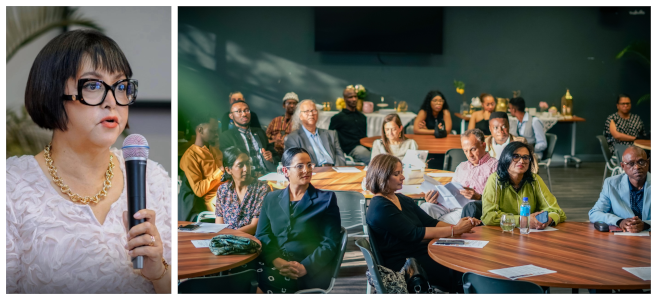
Celebrating her appointment, the College of Humanities recently hosted the launch of the SARChI Chair. Supported by the Deputy Vice-Chancellor and Head of the College of Humanities Professor Nhlanhla Mkhize and hosted by the Dean of Social Science Professor Federico Settler, with input from the UKZN Dean of Research Professor Neil Koorbanally, the event brought together academics from across the country and abroad, working within the space of gender, identity, race, land, religion and culture.
Speakers and panellists included critical thinkers, researchers, directors and experts in identity and cultural studies. Also in attendance were members from The National Question Network (TNQN) from universities across the country.
This is a South African-based network of key stakeholders created by Maart, bringing together key scholars, researchers, community members, grassroots organisers, indigenous people(s), and civil society groups, some of whom included Professor Tshepo Madlingozi, South African Human Rights Commissioner on Anti-racism; Professor Lewis Gordon, University of Connecticut; Professor Sarojini Nadar, Desmond Tutu SARChI Research Chair in Religion and Social Justice; Dr Zethu Mkhize, Director, Centre for Transformation, Stellenbosch University; Dr Sianne Alves, Director, Office of Inclusivity and Change, UCT; and Ms Rose Mzisa, Deputy Director, Department of Science and Technology.
Maart said, “TNQN aims to develop and maintain knowledge-centred relationships with key agencies and structures in South Africa where ‘The National Question’ is unfolding, ensuring transparent communication among all stakeholders.”
Deputy Vice-Chancellor and Head of the College of Humanities Professor Nhlanhla Mkhize congratulated Maart on her appointment, saying, “I am pleased that the Chair has been awarded to you and UKZN. You are more than equal to this task, and we look forward to the Chair flourishing here under your guidance.” He also stressed the continued relevance of ‘The National Question’, noting that it was more important than ever in this historical juncture in South Africa.
Maart also received several messages of congratulations and support from her international peers and colleagues, working in the fields of philosophy, politics, African studies and African American studies.
Professor Tommy J. Curry, the Personal Chair of Africana Philosophy and Black Male Studies from the University of Edinburgh, said, “This is a fitting recognition for Professor Maart, as a world-leading theorist who offers powerful diagnoses of colonialism, anti-Black racism, and the violence imposed upon African peoples. Noting her contributions to Philosophy Born of Struggle, Philosophies Born of Massacres, Black Male Studies, and Academic Philosophy does not adequately capture the significance of her career and research.
“Professor Maart has paved the way for generations of African scholars and has stood against the co-optation of Black thought and philosophy by White liberals and the neo-colonial forces that would have Black thinkers merely accept their marginalised status within predominantly White institutions that show little regard for Black philosophy or the Black experience. She is a sterling example of the best of our people, and this is a wonderful recognition of this fact.”
Renowned philosopher Professor Riccardo Pozzo, Chair of the 24th World Congress of Philosophy Programme Committee, also congratulated Maart and called for increased investment in education and viable pathways to peace and equality.
Maart is taking the appointment in her stride, energised by the possibilities of the role. “It’s been a good start, and I look forward to working with researchers and stakeholders across the country to ensure we achieve our aims and objectives. It is a great responsibility to shoulder, and I am delighted to say that the support has been overwhelmingly positive,” she said.
Words: Jennene Naidu
Photographs: Supplied

You may also like

Meet Our New Director of Innovation and Entrepreneurship

Medical Student’s Grocery Platform Wins Big!
