Professor Fatima Meer Memorial Lecture
The name Fatima Meer is synonymous with the struggle against apartheid in South Africa. Respected as a human rights activist, educator, and author, she was one of the most prominent female political leaders of our time. She shares a lasting legacy with UKZN (former University of Natal) where she was a lecturer in sociology and remained until 1988, as the first person of colour to teach at a White University. Meer was also a devoted mother and dedicated wife.
The annual Professor Fatima Meer Memorial Lecture was initiated by her alma mater three years ago to honour her life’s work and as an opportunity to reflect on societal issues of the day. The lecture took place at the end of August at the Howard College Theatre with the theme Struggles for Freedom from Apartheid: South Africa and Palestine.
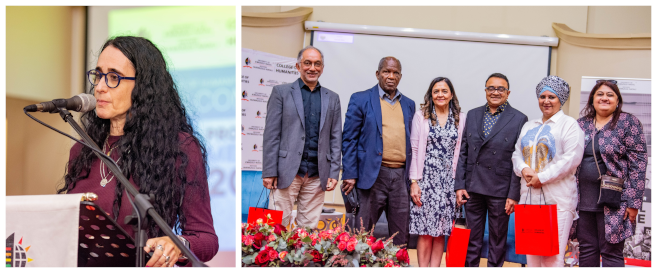
Drawing parallels between the South African struggle and the war currently being waged in Palestine, the keynote speakers included Professor Paulus Zulu, Professor Emeritus and Director of the Maurice Webb Race Relations Unit (MWRRU) at UKZN and Mr Na’eem Jeenah, senior researcher at the Mapungubwe Institute for Strategic Reflection (MISTRA). Academic and researcher Professor Monique Marks completed the illustrious panel, with the proceedings being directed by Professor Dasarath Chetty.
Woven throughout the addresses of both Zulu and Jeenah was the theme of intersectionality of the struggles for justice. The right to self-determination for the Palestinian people was just as important to Meer as the freedom of all South Africans. ‘Meer believed in the indivisibility of justice and that all forms of injustice need to be confronted wherever they take place in the world,’ said Jeenah.
Drawing on his years of friendship with Meer, Zulu stated, ‘if Fatima were here today, she would have reminded us about the ideals for which we fought. It is this spirit that needs to be continued.’ He pondered what Meer would say and do about the moral decay that pervades our society today and asserted, ‘Meer’s diagnosis would be that South Africa is a country alienated from itself and she would probably be both its prophet and saviour, using her visionary leadership and unquestionable integrity to steer us away from the anarchy we face.’
Marks’ response to both speakers highlighted the themes which emerged. She posed a question on the role of academics and universities in bringing societies together. ‘Academia has a critical role to play in creating a common humanity, something which Professor Meer was committed to.’
She also highlighted Meer’s vast contribution to furthering the women’s movement in South Africa and beyond: ‘We are all confronted by the burden of the future and are all responsible for making it as safe as possible.’
An artistic poetry performance by Ms Zohra Moosa who is hearing impaired, complemented the lecture. Moosa signed her emotive poem entitled Echo of Palestine, which moved the audience.
The lecture also included the presentation of the 2024 Clinical Sociology Book Prize presented by Professor Mariam Seedat-Khan and Dr Alabi from the School of Social Science. This year’s winner was Clinical Sociology Honours student, Laureate Ms Sibusisiwe Makhanya. Her research entitled: Examining the Impact of Witnessing Domestic Violence in Childhood Homes on Postgraduate Students of UKZN, Howard College Campus explores the far-reaching effects of gender-based violence.
Makhanya said ‘Professor Meer left an indelible mark on the field of Sociology with her pioneering work which shapes our understanding today. I am honoured and grateful to be this year’s recipient.’
Meant to commemorate, remember and pay homage to the incredible contribution of Professor Meer, the memorial lecture fulfilled and renewed its purpose.
Words: Jennene Naidu
Photographs: Nkosikhona Gcabashe