An invitation to unlearn the coloniality of intimacy and to imagine new frameworks for studying love, family and relational ethics, is how a recent academic paper has been described by Professor Mariam Seedat-Khan of the University of KwaZulu-Natal’s (UKZN) School of Social Sciences.
Said Seedat-Khan, “For scholars in South Africa and across the Global South, this comparative lens offers a reminder that the future of sociology depends not only on adding new cases but on reconstituting the very grammar of relationality that structures our understanding of the human.”
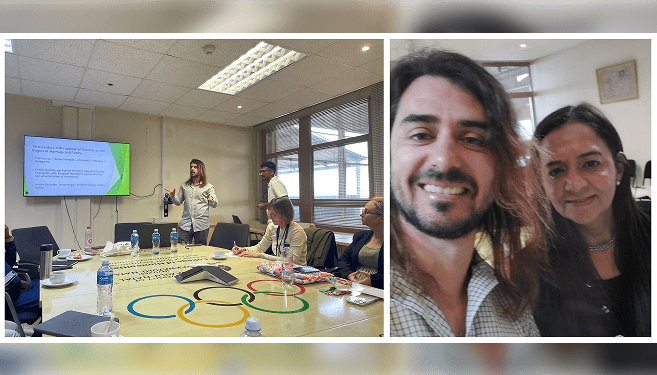
The paper, part of the School of Social Science’s Summer Seminar Series, was presented by Professor Antonio Pilão, a Marie Curie Fellow in the Department of Sociology at Manchester Metropolitan University in England. It was titled: ‘Polygamy and Polyamory: Bridging Research Agendas Across the Global North/South, Representations of Polygamy as Patriarchal and Oppressive, Reinforcing Hierarchical Distinctions Between “The West” and “The Rest”’.
Pilão’s extensive academic background includes being a member of the Contemporary Intimacies, Sexualities and Genders (CISG) research group.
He also leads the Research Group Non-Monogamous Politics, Affects and Sexualities (CNPq Directory) and serves on the International Commission on Global Feminisms and Queer Politics of the International Union of Anthropological and Ethnological Sciences (IUAES).
His provocative presentation demanded a re-investigation of how the politics of intimacy and kinship remain entangled with the histories of colonialism, gender and global inequality. He interrogated the moral binaries of monogamy versus non-monogamy, modern versus traditional and west versus rest, confronting how knowledge about love, family and sexuality continues to be mediated by colonial logics and Eurocentric taxonomies of civilisation.
Pilão also revealed the skewed view of how polygamy in the Global South and in the Global North are presented, arguing that discourses of consensual ‘non-monogamy’ in Western societies are seen as modern, egalitarian and ethical in direct contrast to supposedly patriarchal, ‘traditional’ polygamy in the Global South.
In the South African setting where debates around legal pluralism, gender equality and customary marriage reform remain deeply contested, such a framework allows a reimagining of relational justice beyond the narrow confines of Eurocentric morality.
Given these inconsistencies, Pilão calls for integrative research across non-monogamous practices in the Global North and South, representing an important methodological and epistemological shift. “This comparative sociology of kinship and desire invites us to think relationally rather than hierarchically. It opens space for new genealogies of love and belonging that transcend the binaries of legality and illegitimacy, heteronormativity and queerness, tradition and modernity.”
Responding to Pilão’s presentation and grounding her comments on the South African experience, Seedat-Khan said: “Pilão’s findings are not merely theoretical; they are deeply material, structured by law, economy, gender and race. The valorisation of polyamory as ‘choice’ or ‘freedom’ often assumes access to privilege, time, resources and social safety nets while the same relational multiplicity among African or working-class subjects may be read as moral failure or social pathology. The differential moral valence attached to these forms thus reveals the enduring coloniality of intimacy.”
Words: Jennene Naidu
Photographs: Supplied