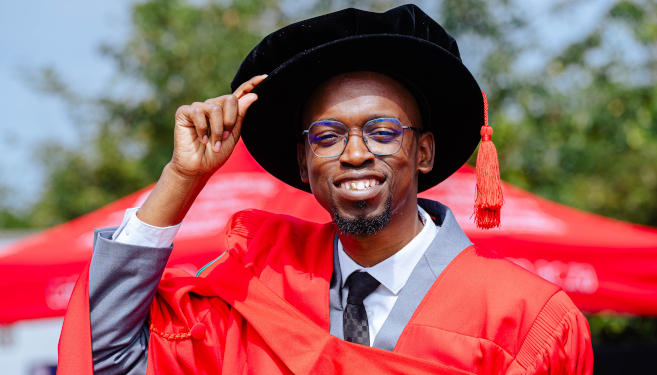
Dr Bongane Mzinyane’s PhD study focused on the practice of adult diversion by probation officers and public prosecutors in a rural district of KwaZulu-Natal (UKZN).
Adult diversion is a legal process that allows adults accused of minor, non-violent crimes to avoid formal court proceedings by participating in rehabilitation programmes or other alternative measures.
Mzinyane’s research is enhanced by over seven years of experience as a social worker in different roles in the criminal justice system where he observed first-hand the critical yet under-regulated practice of adult diversion. He believes that a ‘second chance’ for offenders, operates in a legislative grey area, lacking the formal structure of its counterpart, the Child Justice Act.
He studied probation officers and public prosecutors in the uThukela district to understand their lived experiences and perceptions of the process. The study highlights the challenges and opportunities within this discretionary system and aims to provide a robust framework for improving it while significantly contributing to knowledge by pioneering the scholarly exploration of adult diversion in a South African rural context.
“Adult diversion has not yet been explored in South Africa which makes my study unique,” said Mzinyane. “My research reveals that the pre-trial practice of adult diversion which occurs in courts of law and social work practice is often subjective and inconsistent, given the absence of law that regulates it.”
He says a key finding is that while the roles of practitioners appear structured, the process occurs in the absence of a formal, legislative framework.
The study identified several challenges, including a lack of formal training on adult diversion, limited resources, and varying perceptions among practitioners. Contextual factors like socioeconomic and cultural dynamics in rural areas also play a big role. “My research advocates for legislative reform to formalise adult diversion and proposes guidelines for policy and practice. This study is basically a call to action for policymakers, practitioners and researchers to collaborate on a justice system that prioritises rehabilitation, accountability, and social harmony,” said Mzinyane.
Challenges included navigating a PhD while working full-time as an academic and balancing the roles of being a ‘husband-to-be’, a father, and a son.
“I had the privilege of mentoring master’s students, including Ms Mandisa Thundzi, who recently graduated today. This multifaceted role as a student, mentor, and lecturer, required extra effort on my part to ensure my students’ success while managing my own PhD research and duties as a lecturer in Social Work at UKZN.”
Very exciting for him was returning to uThukela, the rural KZN district where he was born and once served as an employee, but this time as a doctoral researcher. “It was an interesting and nostalgic journey to engage with my former colleagues and understand their professional realities from a new perspective.
“The support I received from my former Dean, Professor Matoane, including her encouragement and providing access to sabbatical leave and a writing retreat, was a game-changer that significantly boosted my progress. I am also grateful to my funders, the Department of Science and Innovation-National Research Foundation (DSI-NRF) scholarship and the University Capacity Development Programme (UCDP) UKZN office which generously provided the resources for my PhD venture to be a success.”
Mzinyane thanked his supervisor Dr Sibonsile Zibane, for her professional and motherly guidance; his mother, MaKhambule, for her constant support, and his family, especially his son, Melokuhle. “My soon-to-be wife provided a balance of love, prayers, and laughter while I was supported by friends, colleagues and supervisors.”
To his peers, he offers simple but profound advice: “Be patient with your journey and open to unlearning in order to grow.”
He provided the following heartfelt dedication to his humble beginnings in eMoba (Peacetown), Ladysmith, and to all those who believe in the power of education: “Nalapho kungakhali khona iqhude, kodwa kuyasa” – Even where the rooster does not crow, the day dawns.
Words: Sinoyolo Mahlasela
Photograph: Sethu Dlamini