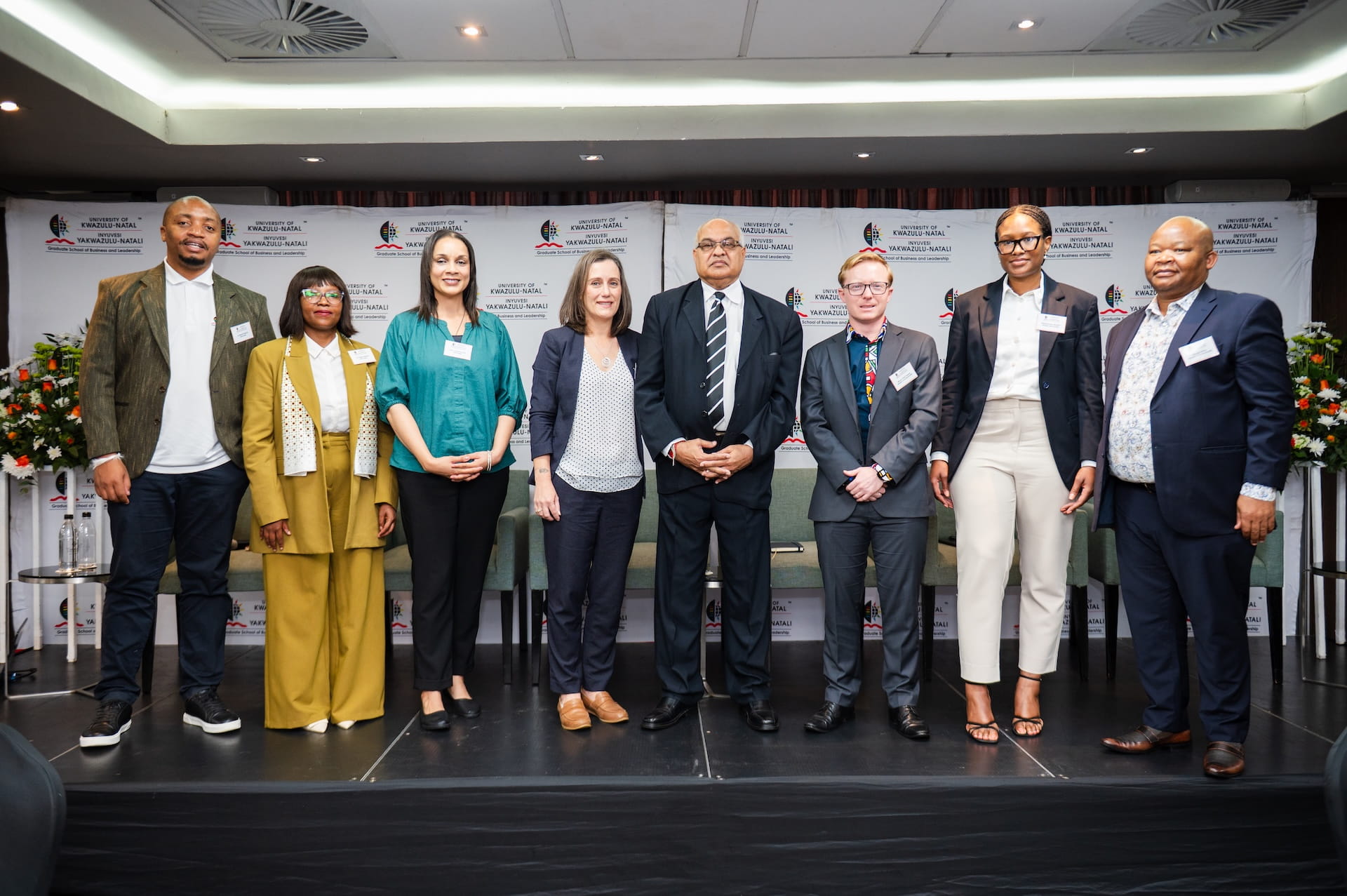
Transformational leadership required to promote good governance and enhanced service delivery at a local level as well as strategies for advancing local economic development (LED) were the focus of discussions at a recent Business Breakfast meeting between the University of KwaZulu-Natal’s Graduate School of Business and Leadership (GSB&L) and the uMngeni Local Municipality.
The GSB&L signed a Memorandum of Understanding (MOU) with the uMngeni Local Municipality which aims to foster a long-term strategic working relationship to promote collaboration on transformational leadership and LED, both theoretically and on a practical level. The activities generated by the partnership should be impactful and benefit both institutions equally in promoting good local governance and citizen centric municipal service delivery.
Umgeni is one of the most successful municipalities in KwaZulu-Natal, and has been lauded for good governance, quality service delivery and for continuously securing a clean audit on an annual basis, among many other plaudits.
The robust local leadership and the best practices of the municipality have been impressive and many believe they need to be replicated provincially and nationally, in the light of the majority of municipalities in South Africa being reportedly in a state of near collapse.
The breakfast meeting provided a platform for the work done by the uMngeni Local Municipality to be highlighted and disseminated to a wider audience provincially and nationally. The event also provided an opportunity for senior academics/researchers, executive/senior municipal functionaries, representatives of the business community and the leadership of civil society to network and engage with the executive members of the uMngeni municipality on transformational leadership, good governance, best practices and strategies for LED.
Speakers from the municipality were the Mayor Mr Chris Pappas; the Municipal Manager Mr Mzingisi Hloba, and the Director of Economic Development, Planning and Human Settlements, Ms Sinenhlanhla Dlamini.
Pappas placed particular emphasis on “political will” to ensure efficient, effective and responsive service delivery at the local level, noting that a defined strategy, partnerships and networking were important as well as understanding jurisdiction as it signified where power was located.
While acknowledging the political turbulence that comes with reform, he also insisted that visible, accountable leadership remained the only path to rebuilding trust. “There is never a win-win in a popularity contest. That is the nature of our sphere of operation,” he said.
Hloba focused on strengthening oversight mechanisms, ensuring responsiveness to communities, appointing appropriately qualified personnel and embedding performance management systems that support quality service delivery. Dlamini spoke about the necessary linkage between good governance and LED, highlighting the need for skills development, securing grant funding, partnering with civil society, developing infrastructure, incentivising industries that are unique and creative, and facilitating inclusive local economies.
Speakers from UKZN were Professor Cecile Gerwel and Dr Mondli Vilakazi.
Gerwel, a leadership specialist in the GSB&L, pointed out that in the current complex times a great deal of responsibility and accountability were required, adding that expectations were high and resources limited. There was also a need for ethical leadership and resilience to navigate the challenges.
Vilakazi, a regional and local economic development specialist, flagged the issue of negative “political will”; the need for a strategy and capacity development, and most important, appointing people able to deliver.
“Local government is indeed at the coalface,” said Vilakazi. “It is seen as the hands and feet of government. Get basic service delivery right at the local level and the result will be an enhanced quality of life for the local population and the support of local communities.
“At present, there is a trust deficit in the relationship between municipalities and local communities, which is likely to impact negatively on the 2026 local government elections,” he added.
The engagement concluded with a shared commitment to strengthening leadership capability, deepening research-informed practice, and supporting municipalities in improving service delivery outcomes for citizens.
Words: Professor PS Reddy
Photograph: Hesper Celes