Imaging Entire Bews Herbarium Collection: a Landmark for Advancing Botanical Research
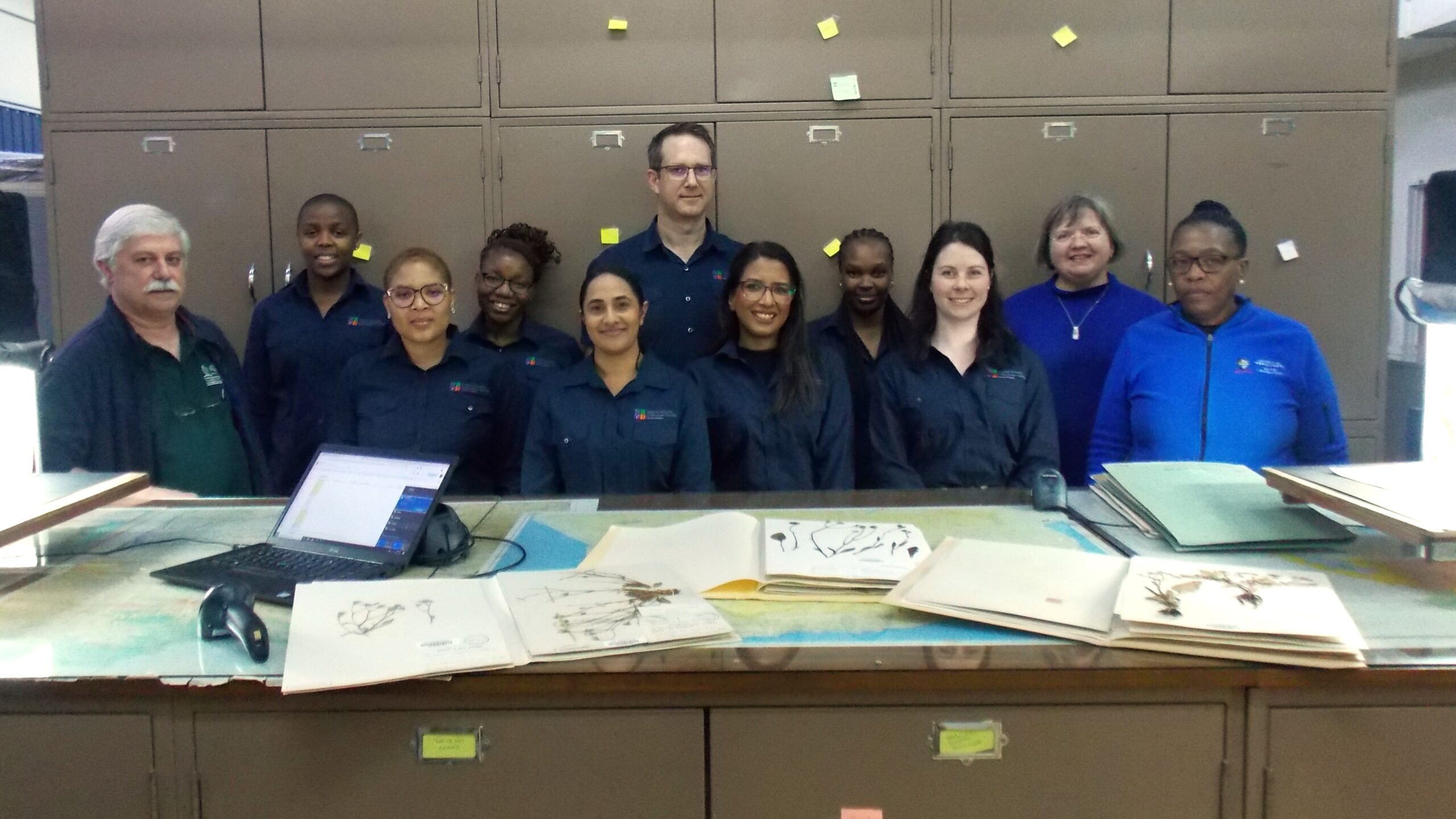
UKZN’s Bews Herbarium in Pietermaritzburg celebrated the completion of a four-month-long imaging process led by the Natural Science Collections Facility (NSCF), advancing the availability of the leading herbarium to support critical research into South Africa’s flora.
As KwaZulu-Natal’s largest herbarium and the fourth largest in the country, the facility documents the flora of the KwaZulu-Natal province and beyond. It has particularly rich collections of asteraceae (daisies), cyperaceae (sedges), fabaceae (legumes), orchidaceae (orchids), poaceae (grasses) and ferns.
The herbarium is named after respected ecologist John William Bews, known for his significant contributions to the understanding of the KwaZulu-Natal vegetation. Bews was the first Professor of Botany and became the first Principal of what was then Natal University College. Founded in 1910, the Bews Herbarium now houses just under a quarter of a million plant specimens, including flowering plants, seed plants, ferns and seaweeds, and each one of these has now been photographed.
As a vital resource for taxonomic, ecological, and conservation studies, researchers, students, and botanists use the herbarium to study plant biodiversity. It also plays a crucial role in documenting and preserving the flora of southern Africa and contributes to zoological, agricultural and weed research. It supports the University’s academic programme through student training on plant collecting, herbarium and plant taxonomic skills, and is part of collaborative research projects with other herbaria, conservation organisations, and botanical institutions.
Professor Benny Bytebier – herbarium curator since 2009 – introduced the internationally used Botanical Research and Herbarium Management System (BRAHMS) software while working towards making the Bews Herbarium the first virtual South African Herbarium to enhance the accessibility of its collections to a broader research and scientific community. Bytebier, together with the collection manager Dr Christina Potgieter, and herbarium technician Ms Prudence Magwaza, have grown the herbarium from an estimated 125,000 specimens in 2009 to almost double by the end of 2024 by incorporating four orphaned herbarium collections. This was done with the crucial support of the NSCF.
‘This is more than just a research collection; it’s a national heritage collection as it records what we have in our country and for that reason alone we have to protect it,’ said Bytebier.
The recent imaging process, which had already begun in recent years with the capture of the orphaned herbarium specimens entering the collection, involved daily imaging of specimens using advanced photographic equipment and was led by Dr Ian Engelbrecht and a team of seven from the NSCF. This formed part of the NSCF initiative’s goals, supported by the Department of Science and Innovation (DSI) and the National Research Foundation (NRF), of improving the management, accessibility and use of South Africa’s natural science collections housed in museums, herbaria and research institutions nationwide.
During the NSCF visit, Engelbrecht also presented a guest seminar to staff and students on his research on arachnids, including spiders and scorpions, and the study and documentation of invertebrate species that play vital ecological roles but are often under-studied. His research addresses species diversity distribution, and the conservation of lesser-known invertebrates in South Africa.
With the support of the NSCF, Bytebier, Potgieter and Magwaza have developed herbarium skills and are working towards making the collection of about 250 000 flat specimens – roughly equivalent to the number of books in the University’s Cecil Reynaud Library – and thousands of microscopy and alcohol specimens available as part of a single online biodiversity centre. These vital records help conserve the nation’s biodiversity by contributing to plant population monitoring and biodiversity assessments.
Words & Photograph: Christine Cuénod (cuenod@ukzn.ac.za)
Keywords: UKZN, Bews Herbarium, Natural Science Collections Facility, Ecology, Botany