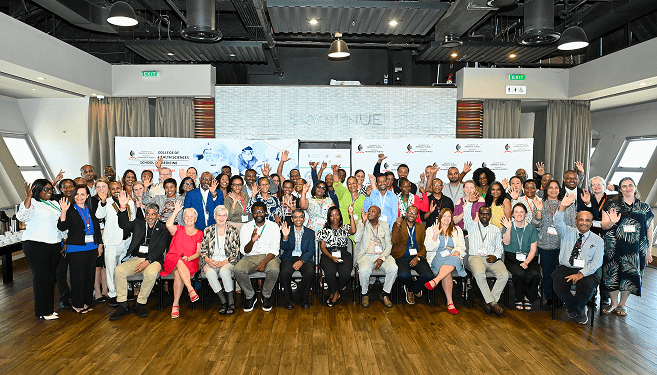
An international research initiative, the Child Heat Impact – Climate Health Intervention (CHI²) project, has been officially launched in Durban.
Spearheaded by UKZN’s College of Health Sciences (CHS), the project brings together scientists and community leaders from Haramaya University (Ethiopia), the University of Zimbabwe, Lund University (Sweden), the University of Gothenburg (Sweden), and the University of Birmingham (United Kingdom) to investigate how climate change, particularly rising heat and air pollution, affects child health in sub-Saharan Africa.
Lead Principal Investigator Professor Rajen Naidoo of UKZN opened proceedings, describing the project as “a bold and necessary response to one of the most pressing and under-recognised public health challenges of our time.” Naidoo emphasised that while climate change was global, its effects on children’s health were disproportionately severe in Africa, where heat waves, droughts and air pollution continued to escalate.
The CHI² project will study the impacts on 900 primary school children – 300 from Durban, 300 from Ethiopia and 300 from Harare. In Durban, two schools will form part of the study – one in KwaMashu and the other in Wentworth.
A participating school, Assegai Primary, lies between two major oil refineries in Durban. Communities in the area have faced decades of air pollution, high unemployment, and social challenges, now worsened by extreme heat and flooding. Children there experience respiratory illnesses, heat-related fainting and concentration difficulties during lessons, prompting urgent concern from educators such as the principal of Assegai Primary Mr Neil Blackenberg, who said: “At the height of summer, classrooms become unbearable. Some children collapse, while others can’t focus. We’ve had to change uniforms, physical education times, and have even introduced daily ‘cool-down breaks’ to cope,” he explained.
The CHI² research will conduct comprehensive health and environmental exposure assessments in the children’s homes, schools, and recreational areas. Using ground-based monitoring and meteorological data, researchers will map exposure to heat and air pollution, assess lung function and early airway disease, and explore how maternal exposure affects foetal development. The findings will help develop scalable interventions and policy frameworks to protect child health and promote climate resilience.
Ms Shanice Firmin, representing the South Durban Community Environmental Alliance (SDCEA), highlighted the real-life consequences of living with industrial pollution. “Our children are growing up in toxic environments. We’re seeing asthma, chronic lung disease, and even cancer. The CHI² project gives us the scientific backing to advocate for change – like establishing a 24-hour cancer clinic and protecting our green spaces,” said Firmin.
The day’s proceedings included an engaging stakeholder workshop involving representatives from eThekwini Municipality, the SDCEA, the Durban Coalition, and the KZN Department of Health, who discussed strategies for building community resilience, improving policy co-ordination and ensuring that evidence from CHI² translates into real-world health interventions.
Deputy Vice-Chancellor of UKZN’s College of Health Sciences Professor Busisiwe Ncama lauded the project as “a demonstration of how science, policy, and community partnership can unite to safeguard our most vulnerable citizens – our children.”
The CHI² initiative is not only a response to immediate climate threats but also a blueprint for global collaboration in environmental health research. As Naidoo concluded: “We cannot change the climate overnight but we can change how we prepare for it. Every child deserves to grow, learn and thrive in an environment that supports their health and future.”
Words: MaryAnn Francis
Photograph: Supplied