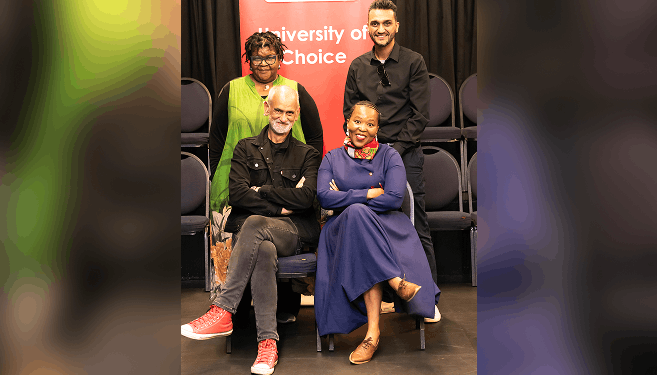
The University of KwaZulu-Natal (UKZN), through collaboration between the School of Social Sciences, the School of Arts and the Centre for Creative Arts, hosted ‘Freedom to Create, Freedom to Silence: Exploring Art and Censorship’, an ongoing dialogue exploring the intersection of artistic expression and censorship.
The initiative critically examines the tension between protecting creative freedom under Section 16 of the South African Constitution and the forces that seek to silence or restrict controversial works. The event was held at the Hexagon Studio Theatre at UKZN’s Pietermaritzburg campus recently and was attended by academics, artists, students and members of the public.
The two-pronged programme opened with a reading of acclaimed South African playwright, Mr Mike van Graan’s play Abraham’s Promises, which explored the Israel-Palestine conflict, and the historical, political and religious factors behind it.
The second session was a panel discussion chaired by Dr Mohammed Vawda, with Mr Mike van Graan, Ms Waron Seane, and Ms Ukhona Mlandu as panellists.
“In South Africa, these conversations carry particular weight, as we come from a history where art, theatre, music, poetry and performance were often treated as dangerous because they helped people imagine freedom before freedom had formally arrived,” said Vawda. He also noted that modern censorship in a constitutional democracy is more complex than simple burning of book or closing theatres. Instead, he said, it frequently manifests as political pressure, funding cuts, social media backlash, or pre-emptive institutional fear. Ultimately, he warned that censorship can take its most insidious form within the confines of committee meetings.
Van Graan argued that artistic freedom is meaningless without economic support, stating that art should be funded as a public good to combat structural inequalities within the industry.
The main barrier is not a lack of creativity, but a lack of production resources. He emphasised that governments must fund artists regardless of their political stance, concluding that while authorities claim to protect expression, they often only support those who ‘don’t rock the boat’.
Mlandu argued that government oversight and systemic gatekeeping dictate artistic value, often restricting creative freedom and excluding or marginalising certain artists. In virtual and traditional spaces alike, institutions artificially create scarcity by controlling visibility. Furthermore, she criticised a culture that shames artists for pursuing commercial sustainability, emphasising that financial security is crucial for survival and escaping poverty.
Seane spoke on self-censorship and economic pressure, saying people, especially on social media, avoid certain terms so as not to offend or trigger others, avoid losing audiences and having content removed. She further highlighted how government, society and institutions can restrict creativity by controlling what can be freely expressed. She also touched on the struggle to raise funds versus marketability and support. She urged universities to better prepare art students for the industry, also challenging students to consider ways to resist systems that may censor or oppress them.
Panellists also shared practical career advice with students, including building skills development, using university resources to their advantage, networking, and adapting to industry changes.
Words: Neliswa Phungula
Photograph: Tisetso Nhlapo