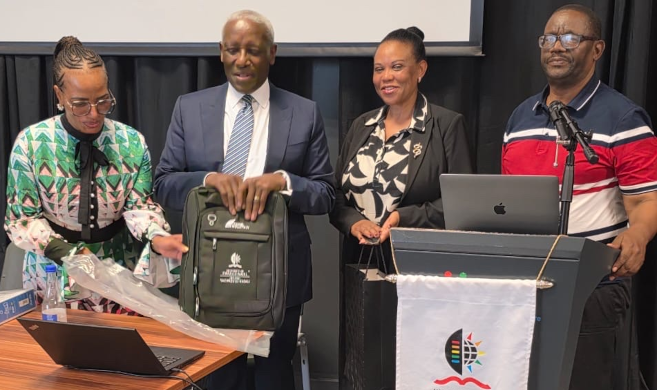
From left: Professor Halima Khunoethe, Justice Sandile Ngcobo, Professor Pearl Sithole, Mr Themba Mzimela.
The Maurice Webb Race Relations Unit (MWRRU) at Howard College recently hosted former Chief Justice Sandile Ngcobo as part of its ‘Administration of Justice’ module.
The lecture formed a key component of the Leadership and Governance Programme, launched in early 2025 as a capacity-building initiative for traditional leaders. The programme is a partnership between the KwaZulu-Natal MEC for Co-operative Governance and Traditional Affairs (COGTA) and the MWRRU.
MWRRU Director, Professor Paulus Zulu, expressed deep appreciation for Ngcobo’s participation, describing him as an exceptional jurist whose insights are enriched by a profound understanding of local cultures and communities.
Over an interactive two-day session, Ngcobo provided a comprehensive and holistic perspective on the administration of justice in South Africa. His approach positioned communities at the centre of the justice system, emphasising a balance between individual rights, cultural traditions, and democratic values.
The lecture invigorated amakhosi who engage daily with community-based challenges. Ngcobo highlighted the Constitution as a powerful enabler of administrative justice and demonstrated how policy frameworks aligned with it support ethical leadership and effective governance. He further illustrated how ethics, inhlonipho, and ubuntu operate as foundational principles for sound policy implementation and administrative decision-making.
Across the two days, Ngcobo guided the class through key themes, including:
The social life, ethos, and evolving governance systems of indigenous communities;
The relationship between community governance, land, agriculture, and socio-economic survival;
The impact of colonialism on community structures;
The transformation of policy tools from instruments of colonial control into shared frameworks reflecting South African values;
The Constitution of the Republic of South Africa and the legislation governing the relationship between local government and traditional leadership.
As a key partner in the programme, the Department of Cooperative Governance and Traditional Affairs attended the lecture and recognised the intellectual value and inspiration it provided to the Class of 2025.