
Film Degree Development Workshop to Strengthen Media and Film Education
- Posted by ukzn-admin
- Categories News
- Date November 11, 2025
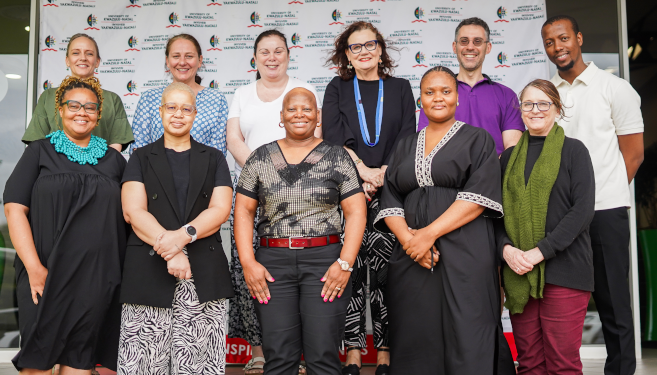
UKZN hosted a Film Degree Development Workshop involving leading industry experts and academics to help guide the development of a new qualification with a strong film pathway, fully integrated with Media and Cultural Studies.
The three-day event, chaired by Professor Michelle Stewart, aligned with UKZN’s renewal and positioning strategy which seeks to address critical skills gaps in South Africa’s growing film and media sector.
Academics were from the College of Humanities’ Howard College Campus Media and Cultural Studies (MECS), and the Centre for Communication, Media and Society (CCMS), under the Cultural Studies, Media and Fine Arts (CSMFA) Discipline.
Dean and Head of the School of Arts, Professor Nobuhle Hlongwa, officially welcomed participants, offering background on the University’s restructuring process and the integration of existing Howard College MECS, CCMS, and School of Arts modules on the Durban campus. Hlongwa emphasised that the workshop formed part of a broader effort to ensure that academic offerings remained relevant, sustainable and responsive to industry and national development priorities. She said UKZN, through the Centre for Creative Arts, ran the biggest film festival in Africa – the Durban International Film Festival (DIFF) – and for this reason it was vital that UKZN provided full training in film studies.
The workshop focused on several key objectives with contributions from an industry expert in Media Law and Business, Ms Zama Mkosi; the Managing Director of Stained Glass TV, Ms Mariki van der Walt; Creative Director of Stained Glass TV, Mr Mthunzi Dubanaza; Industry Expert in Film Exhibition and International Acquisitions, Ms Diane Hay; Ms Nosipho Hlophe and Mr Bongumusa Ntuli of eThekwini Municipality’s Durban Film Office; National Film and Video Foundation representative, Mr Leron Adonis; and seasoned academics from the School of Arts.
Objectives included:
- Defining a graduate profile outlining the knowledge, skills, and attributes expected of postgraduates
- Exploring curriculum design by mapping backwards from the graduate profile to undergraduate outcomes
- Integrating existing modules and pathways across disciplines to enhance relevance and resource efficiency
- Identifying curriculum gaps and opportunities for new modules and specialisation streams
- Embedding Work Integrated Learning (WIL) to align academic training with professional practice
- Developing staffing, infrastructure and funding models to leverage existing resources
- Establishing an advisory board to ensure long-term curriculum relevance, industry integration and sustainability
Participants also brainstormed the degree structure, examining admission requirements, core and elective modules, Duly Performed (DPs), credits and the National Qualifications Framework (NQF) compliance as well as potential specialisation streams such as Cinematography, Screenwriting, Post-Production and Media Business.
The second day of the workshop, which focused on staffing, infrastructure, and resource planning, began with Professor Lauren Dyll outlining the blueprint the new degree would follow, as introduced on the first day. School Manager in the College of Humanities Mr Calvin Thomas led the session with a detailed presentation on staffing needs assessment, covering academic, technical and production staff requirements as well as the potential involvement of industry mentors and guest lecturers.
Thomas outlined infrastructure and equipment needs, including studio spaces (audio, video and green screen), editing suites, production gear, digital platforms and IT support.
Dr Luthando Ngema facilitated the subsequent session on WIL components, discussing models for industry placements and internships, and potential collaborations with film festivals and studios.
The group also deliberated on a funding strategy, exploring government, private sector, and grant-based support, as well as strategic partnerships with organisations such as the Durban Film Office, KwaZulu-Natal Tourism and Film Authority, Stained Glass TV, UKZN’s Corporate Relations Division (CRD), and Centre for Creative Arts (CCA).
The final day, facilitated by Stewart, focused on strategic engagement, funding and the formation of an advisory board. Joined by a delegation from the UKZN CRD unit, including Director of Communications, Mr Bhekani Dlamini; Director of University Relations, Ms Xoliswa Zulu, and Strategic Communications Manager, Mr Bheki Mbanjwa, participants reviewed the draft degree framework and presented work-integrated learning opportunities to potential industry partners.
The session concluded with funding discussions exploring collaborative models and developing motivations for funders and stakeholders to support the new degree.
Led by Mr Mzwandile Makhanya, an MECS and Film academic who organised the event, the workshop marked a significant step towards establishing a dynamic, industry-aligned film qualification within UKZN’s College of Humanities.
By integrating existing academic strengths with practical film and media applications, the initiative aims to produce graduates equipped with critical, creative and technical expertise ready to contribute meaningfully to South Africa’s growing creative economy.
Words: Nombuso Dlamini
Photograph: Yola Ndzabe

Previous post
Research Celebrated at College of Law and Management Studies Colloquium
You may also like

An Evening of Reflection, Advocacy and Solidarity

Research Celebrated at College of Law and Management Studies Colloquium
