
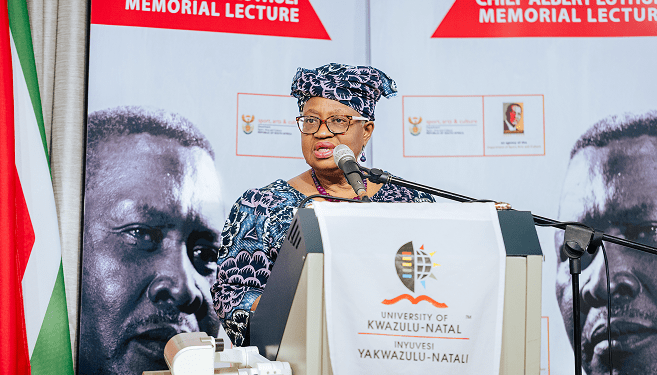
Chief Albert Luthuli Memorial Lecture Puts World Trade Organization Under Spotlight
- Posted by ukzn-admin
- Categories News
- Date December 11, 2025
‘Reflecting on the Work of the World Trade Organization (WTO) and its Global Impact’ was the theme of the 19th Chief Albert Luthuli Memorial Lecture delivered by the organisation’s Director-General Dr Ngozi Okonjo-Iweala and co-hosted by University of KwaZulu-Natal (UKZN) on the Westville campus.
The other hosts were the Luthuli Museum, the Luthuli Foundation, and the Department of Sport, Arts and Culture.
The prestigious annual lecture honours the legacy of Chief Albert Luthuli, Africa’s first Nobel Peace Prize laureate, celebrated for his unwavering commitment to peace, justice, human dignity and global cooperation.
Welcoming guests, Deputy Vice-Chancellor (DVC) and Head of UKZN’s College of Humanities Professor Nhlanhla Mkhize highlighted the significance of the gathering, saying: “The 2025 lecture presents an important opportunity to engage with Dr Okonjo-Iweala on the relevance, challenges, and future of the World Trade Organization (WTO) and its role in shaping a fairer global economic order – an aspiration closely aligned with Chief Luthuli’s vision of peace and shared prosperity.”
Okonjo-Iweala is a globally acclaimed economist, finance expert and international development leader with over 40 years of experience across continents. She has served in senior roles including the:
- Chair of the Board of Gavi, the Vaccine Alliance
- Chair of the Global Commission on the Economy and Climate
- Former Managing Director of the World Bank
- Finance Minister of Nigeria (twice)
- Director-General of the World Trade Organization (current)
Okonjo-Iweala’s address focused on the WTO’s 30-year journey, its achievements, its shortcomings, and the increasingly complex global trade environment defined by geopolitical tensions, shifting alliances and rapid technological advancement.
She reflected on the WTO’s central mission: promoting free and fair trade, mediating trade disputes, and fostering international economic co-operation. She highlighted that the WTO was, at its core, an institution focused on improving people’s lives by enabling jobs, development and stability through trade.
The lecture explored interregional trade and integration efforts in Africa and South America with Okonjo-Iweala questioning whether these initiatives could succeed within a global system marked by competing national interests and power imbalances, particularly for developing nations.
A major area of concern discussed was the rise of AI and its implications for intellectual property rights and international trade. Okonjo-Iweala reflected on how global trade rules might evolve to address emerging challenges in technology governance.
Okonjo-Iweala opened her keynote with a heartfelt tribute to Luthuli’s legacy of moral leadership. She reflected emotionally on Nigeria’s longstanding solidarity with southern Africa’s liberation struggles, including historical sacrifices such as Nigerian civil servants allowing deductions from their salaries to fund anti-apartheid efforts.
She congratulated South Africa for hosting the first-ever G20 Summit on African soil, and celebrated the African Union’s recent membership of the G20 – a breakthrough moment for Africa’s influence in global decision-making.
Drawing a historical link, she connected Chief Luthuli’s strategic use of economic boycotts and emphasised that a strong, rules-based trading system was essential in protecting smaller economies from global power asymmetries.
Okonjo-Iweala outlined the evolution of the global trade system – from post-World War II reconstruction to the Bretton Woods institutions, the GATT, and the formation of the WTO. She pointed out how earlier trade agreements had largely excluded developing nations and sectors such as agriculture and textiles, which disadvantaged African economies for decades.
She highlighted the continent’s limited participation in global trade. Africa’s share remained below 3%, constrained by infrastructure deficits, weak industrial capacity, and slow economic growth in key economies.
Okonjo-Iweala warned that the escalation of unilateral tariff measures – particularly by major global powers – threatened the stability of the rules-based trading system, noting that countries such as South Africa, Lesotho, and Madagascar had already felt the consequences of sharp tariff increases from the United States.
Despite global tensions, she argued passionately that the WTO remained indispensable. Quoting Nelson Mandela, she reaffirmed that a fair, rules-based trading order “is fundamentally correct” and urged African nations to be more assertive in shaping the trade systems that affect their development.
Her concluding message was clear: Africa must seize the opportunity to influence global trade reforms in ways that promote inclusive growth, shared prosperity and the peaceful world Luthuli envisioned.
Her extensive global experience and leadership made her an apt choice for this memorial lecture.
The lecture once again served as a reminder of Luthuli’s enduring relevance.
Awarded the Nobel Peace Prize in 1960, he believed deeply in the interdependence of nations, urging in his address for world powers to “curb their ambitions” and commit to the peaceful settlement of disputes.
His values resonate strongly today in a world grappling with conflict, mistrust, and heightened global competition.
Words: Nombuso Dlamini
Photograph: Sethu Dlamini

You may also like

Youngsters Hear about Skills Needed in a Changing World

‘All Aboard’ Workshop for New UKZN Staff Members
