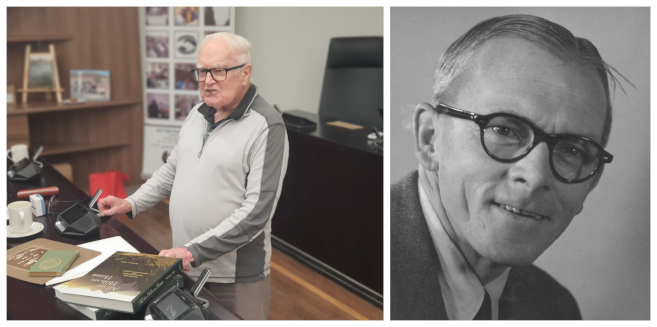
The University of KwaZulu-Natal (UKZN) Library Services and Special Collections at the Alan Paton Centre recently hosted the 2025 Alan Paton Lecture virtually. The lecture, themed ‘Alan Paton – His Early Years’, explored the formative years of South Africa’s celebrated author and anti-apartheid activist Alan Paton.
Delivering the lecture was Mr Malcolm Pearse, son of R.O. (Reginald Oliver) Pearse, a close friend and university contemporary of Alan Paton. He shared personal recollections and insights drawn from family archives. Pearse highlighted the enduring friendship between his father and Paton, which began at Natal University College (now UKZN) and lasted for decades.
“My father and Alan Paton met at the Natal University College in Pietermaritzburg and remained close for 60 years,” Pearse said. “I can still picture our families gathered around the dinner table, with Alan discussing his political views and my father responding accordingly.”
Pearse drew extensively from Paton’s autobiographies, Towards the Mountain and Journey Continued, as well as from a private collection of family memorabilia. He presented historic items, such as a booklet titled Rab and his friends, given by Paton to Mr Malcolm Pearse’s grandparents in July 1921, and a letter from Alan Paton to R.O. Pearse written in 1973, in which Paton praised Barrier of Spears, his father’s acclaimed book on the Drakensberg.
The lecture also highlighted the values Paton shared with his contemporaries, including a love of literature, poetry, debate and faith. Pearse discussed the establishment of the Students’ Christian Association youth camps on the Natal South Coast.
Referencing Paton’s writing, Pearse noted the author’s commitment to confronting injustice. Quoting Cry, the Beloved Country, he said: “The great red hills stand desolate, and the earth has torn away like flesh … The lightning flashes over them, the clouds are the red blood of the earth. Down the valleys women scratch the soil that is left, and the maize hardly reaches the height of a man. They are valleys of old men and old women, of mothers and children. The men are away. The young men and the girls are away. The soil cannot keep them anymore.”
Pearse explained that Paton’s work was not intended to romanticise South Africa, but to reveal and address its social injustices, laying the groundwork for his lifelong advocacy for a just and democratic society. The lecture concluded with Pearse doing a presentation of his father’s personal copy of Cry, the Beloved Country, one of the earliest editions printed in New York in 1948. The book was inscribed by Paton: “R.O.P., from A.S.P., 1904-48.”
Through his reflections, Pearse brought to life the friendship between his father and Paton, which helped shape Paton’s formative years. The lecture reinforced his legacy as a literary and moral icon, whose influence continues to inspire the UKZN community and beyond.
Words: Namisile Zuma
Photographs: Supplied