Adolescent Sexual Behaviour Under the Spotlight in New Book
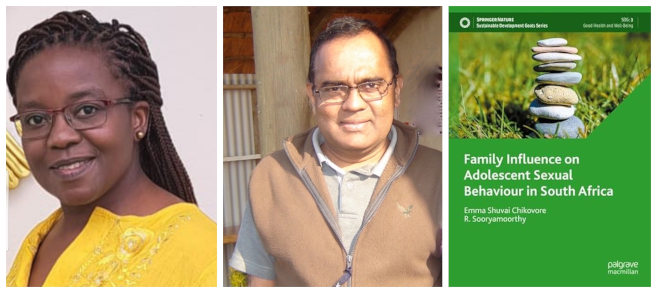
The interplay of family structure, circumstances and parental engagement with adolescent sexual behaviour is examined in the book: Family Influence on Adolescent Sexual Behaviour in South Africa authored by two UKZN academics, Dr Emma Shuvai Chikovre of the School of Built Environment and Development Studies and Professor Radhamany Sooryamoorthy of the School of Social Sciences.
Professor Sampson Lee Blair of the State University of New York commented that ‘the book represents a major advancement in our understanding of the complex nature of sexual activity during adolescence and offers a very insightful explanation of both the causes and potential consequences, thereof, within the context of South Africa.’
The authors explain that ‘adolescent sexual behaviour is profoundly influenced by various factors, including family type and structure, household socioeconomic status, parent-child communication, parent-child closeness, and peer influence. The family environment, whether single-parent, nuclear, or blended, shapes adolescents’ attitudes and behaviours towards sex, while socioeconomic status affects access to resources and support systems.’
They believe that open and supportive communication between parents and adolescents fosters informed decision-making and healthier sexual practices, bolstered by strong parent-child bonds. ‘Peer relationships significantly influence adolescents’ sexual attitudes and behaviours, highlighting the importance of understanding and addressing these multifaceted dynamics to promote positive sexual development and well-being among young people,’ said Soorymoorthy.
The authors drew from the longitudinal Cape Area Panel Study (CAPS), encompassing more than 4 000 adolescents age between 14 and 22. Incorporating qualitative insights from interviews and focus group discussions with both parents and adolescents, the study represents a pioneering empirical investigation into the complex realm of family dynamics and its impact on adolescent sexual behaviour in South Africa.
Said Professor Joshua Oyeniyi of the Obafemi Awolowo University in Nigeria: ‘It is a meticulously crafted book that explores the impact of the family on shaping sexual behaviour within the South African context. Employing a sequential explanatory mixed-methods approach, Chikovore and Sooryamoorthy’s empirical work stands out for its richness and depth.’
Sooryamoorthy said the benefit of the book lay in its inherent policy implications, rendering it remarkably pertinent and up-to-date. ‘In various African nations, concerted efforts have been directed towards formulating policies addressing aspects of family, reproductive sexual health, and the challenges posed by epidemics such as HIV/AIDS.
‘Findings from this research bear immense significance for this purpose, extending their relevance not only to South Africa but to other countries within and beyond the continent.’
He urged students, teachers, practitioners, social workers and policymakers to make use of the book published by Palgrave Macmillan under its Sustainable Development Goals series (https://link.springer.com/book/10.1007/978-3-031-50377-1).
Words: Sinoyolo Mahlasela
Photograph: Supplied