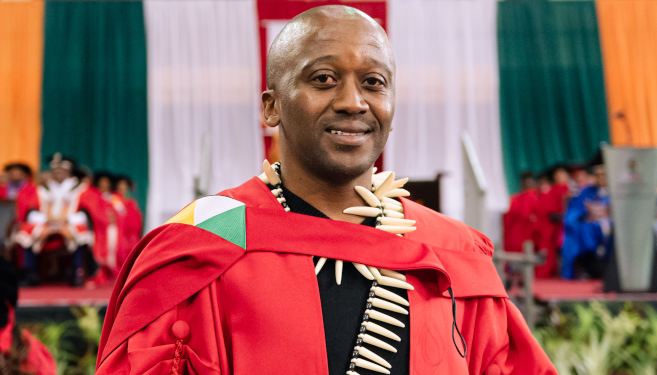
A Father’s Love and the Red Gown
Inspired by his late father’s wish to become the first in his family to graduate with a PhD and don the coveted “red gown” proved to be the motivation behind Dr Sicelo Cyril Shabalala’s achievement.
Graduating with his Doctor of Philosophy in isiZulu Studies, the University of KwaZulu-Natal academic can rest assured that he has made his father proud.
Raised in an urban environment, Shabalala’s interest in isiZulu studies stemmed from a need to delve deeper into understanding more about his own Zulu culture and tradition. Aligned with UKZN’s Language Policy that promotes indigenous languages, he knew that he wanted to pursue his PhD at UKZN, ranked among the best universities in the world.
Titled: An Analysis of The Depiction of Males in Selected Postcolonial Novels Written in isiZulu, Shabalala’s thesis focusses on the stereotypical depiction of males from a masculinist literary criticism.
The novels and texts selected, using purposive sampling, were from the literary period between 1996-2017. His research uncovers the stereotypes that are used to portray men in literary texts and reveals that the traditional role of men in society and in families has not changed in line with the democratic dispensation.
His analysis of male characters within the novels selected reveal that men are depicted as not having any domestic obligations and it is women who take on the role of being a cook, cleaner and caretakers of children.
Shabalala’s research and findings suggest that there is little progress towards gender equity and that men, in their homes, still favour gender inequality. Household chores are arranged according to gender with women performing most of the tasks. Men expect absolute obedience from women, as their word is final, with wives never refuting the word of her husband. The man is the head of the family and provide for women, children, and the extended families. However, those who cannot provide feel emasculated and resort to crime.
‘Women expect protection from men; therefore, men assume the role of a protector. Men do not succumb to emotions. They have been socialised not to cry even in taxing situations. Boys and men are territorial and are risk-takers – they drive recklessly while under the influence of alcohol. They have multiple sexual partners even though HIV and AIDS is at its peak. The number of sexual relations one has is a validation of masculinity. Society praises brave men while mocking acts of cowardice. Boys aspire to be warriors,’ said Shabalala.
He revealed that his research forced him to confront and unlearn gender roles that he had learnt throughout his childhood and formative years. He said, ‘I learnt that what I believed to be aspects of masculinity were indeed gender stereotypes and that masculinity is a social construct.’
Professor Nogwaja Zulu who served as Shabalala’s supervisor, offered him heartfelt congratulations on his achievement saying, ‘Congratulations and well done to Dr Sicelo Shabalala. He has been a good student.’
Managing to complete his PhD in a relatively short period of time, the isiZulu lecturer attributes this accomplishment to the support given to him by his family. ‘I was not alone in this process. My family, especially my sister, kept me on track by keeping a copy of my work plan with all my submission dates. She also proofread my work before I submitted. Without my family, this dream of getting a PhD in record time would not be possible. I truly appreciate your support. May God protect you. Your love and support are the wind beneath my wings.’
He plans to further his research in isiZulu Studies and publish his findings in order to help build the catalogue of research on the subject. Shabalala is also intent on pursuing a Masters in Industrial Psychology in the future.
Words: Jennene Naidu
Photograph: Sethu Dlamini